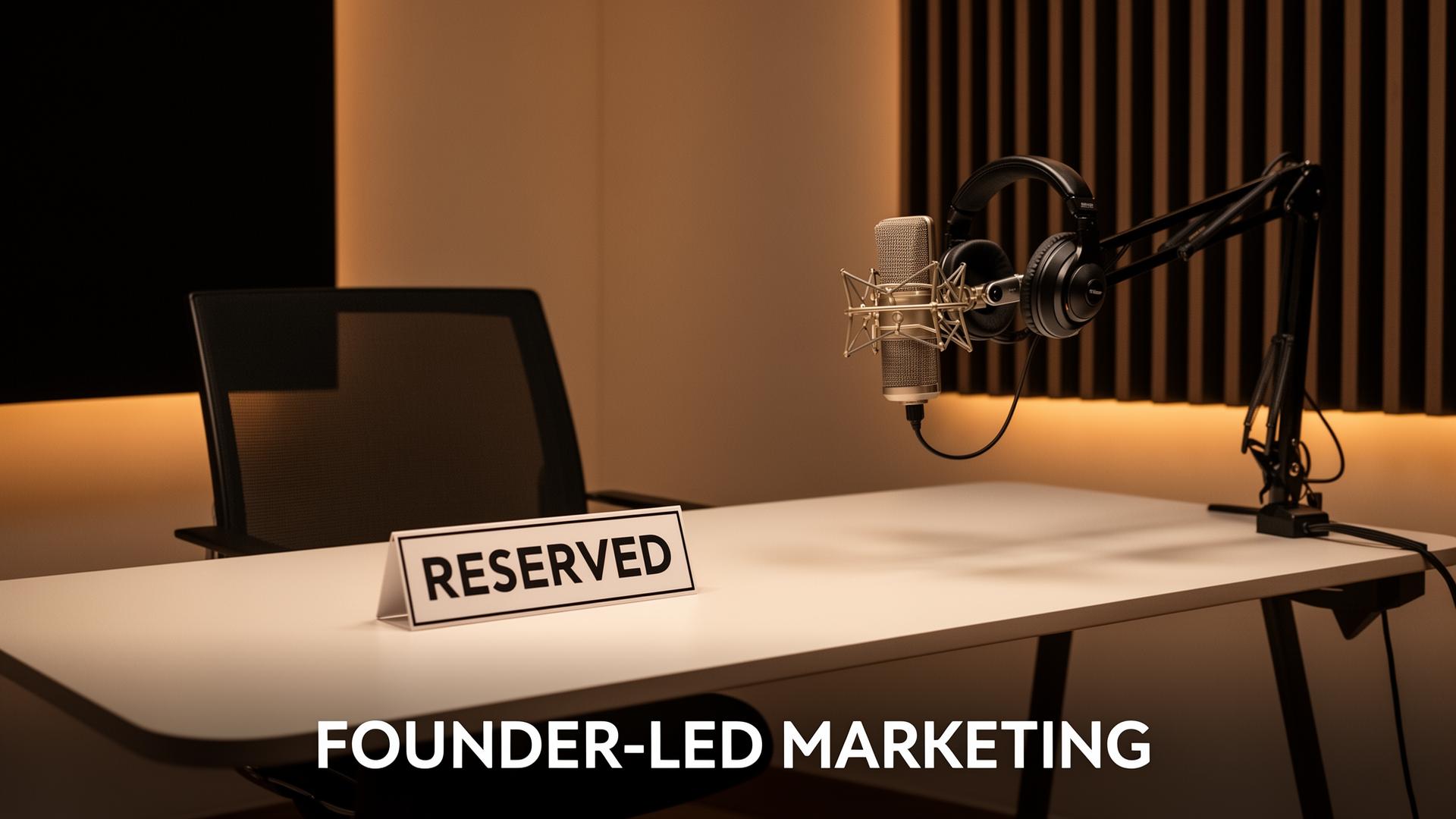
Why Founder-Led Marketing Wins Now
Across early-stage startups and scaleups, I see the same pattern repeat.
The moment a founder starts sharing clear, honest thinking about their market, their customers, and the hard decisions behind the product, three things happen almost immediately:
- 1
Sales conversations get warmer and shorter
- 2
Inbound quality improves even if volume does not
- 3
Hiring becomes easier because the company feels real
This works because founder-led content creates something most B2B brands are missing today: credibility that cannot be generated by a template.
In a world where AI can write "good enough" copy in seconds, the scarce asset is judgment. Buyers want to know how you think, not just what you sell. They want to understand how you see the problem, where you disagree with the market, and what you have learned the hard way.
Founders are uniquely positioned to deliver that signal. No brand campaign can replace it.
For Israeli B2B scaleups in particular, this levels the playing field. You do not need a massive budget to compete with US giants. You need clarity, consistency, and a point of view that reflects real experience.
The Founder-Led Marketing Maturity Model
Most founders fall into one of three stages. Knowing where you are matters more than copying tactics.
Most founders stall in the Reactive stage. They post when they "have something to say" instead of deciding what they want the market to understand about them.
The shift to Systematic is where founder-led marketing becomes a real growth engine.
| Stage | What It Looks Like | What To Do Next |
|---|---|---|
| Silent | No posting. Marketing fully delegated. | Share one raw insight weekly. Something you learned, decided, or changed your mind about. |
| Reactive | Occasional posts tied to events or launches. | Define one core belief you want to be known for and publish around it consistently. |
| Systematic | Clear cadence, repurposing, and intent tracking. | Connect founder activity to pipeline and sales conversations. Optimize, do not just post. |
A 90-Day Playbook CEOs Can Actually Run
This does not require becoming an influencer or spending hours online. Done right, it takes focus, not time.
Weeks 1–4: Define Your Point of View
Pick one sharp angle where you have earned the right to speak.
Examples:
Why your market is measuring the wrong thing
Where buyers misunderstand the real cost of the problem
What most vendors promise but cannot actually deliver
Write four short posts. Each one should include:
• The problem as you see it
• Your perspective or decision
• A question that invites disagreement
Clarity matters more than polish.
Weeks 5–8: Build Cadence and Signal
Post twice a week:
One insight post about the market or category
One story post about a real moment: a failed deal, a customer conversation, a hard trade-off
Do not optimize for likes. Optimize for replies and DMs. Those are early intent signals, not vanity metrics.
Weeks 9–12: Measure What Actually Moves Revenue
Founder-led marketing shows up in conversations before it shows up in dashboards.
Ask in sales calls: "Did you see or read anything from us before reaching out?"
Tag those signals in CRM. Track:
Opportunities influenced by founder content
Sales cycle length for those deals
Deal quality and expansion potential
This is where most teams stop too early. Measurement turns expression into a system.
Common Objections and Why They Miss the Point
"I am not a writer."
You already explain complex ideas to customers, investors, and employees every week. Writing is just thinking in public.
"I do not have time."
Founder-led marketing replaces other activities. One fewer internal meeting often pays for a month of content.
"This will not move the needle."
It rarely moves the needle immediately. It shortens distance. The revenue impact comes later, but it compounds.
Where Fractional Leadership Comes In
At a certain stage, founder-led marketing stops being about posting and starts being about orchestration.
This is where many founders get stuck.
They have strong thinking and real insight, but no time, consistency, or system to translate it into a steady market signal.
Founder-led does not mean founder-written.
A strong fractional CMO acts as a thinking partner and narrative architect. They extract insight from conversations, voice notes, meetings, decisions, and real moments, then shape it into clear, authentic content in the founder's voice.
The founder supplies judgment, perspective, and point of view.
The system supplies consistency, structure, and execution.
In practice, the fractional CMO:
Shapes founder insight into a coherent narrative
Decides which ideas are worth amplifying and which are noise
Connects founder voice to GTM priorities and sales conversations
Ensures authenticity without burning the founder out
Turns sporadic expression into a repeatable growth engine
The goal is not more content.
The goal is alignment between how the founder thinks, how the company sells, and how the market understands the value.
When done right, founder-led marketing feels personal, consistent, and real, even though the founder is not sitting down to write every post.
The Real Opportunity in 2026
AI has removed the execution bottleneck.
Voice and judgment are now the constraint.
Founder-led marketing is not a trend. It is a response to a market that no longer trusts abstraction. The founders who treat their voice as a strategic asset will build trust faster, sell with less friction, and scale with more leverage.
The rest will keep buying attention while wondering why growth feels harder every quarter.
Ready to turn your voice into a growth engine?
If you are a founder looking to build a systematic approach to founder-led marketing, let's discuss how fractional CMO leadership can help you move from reactive posting to a repeatable system that drives pipeline.